

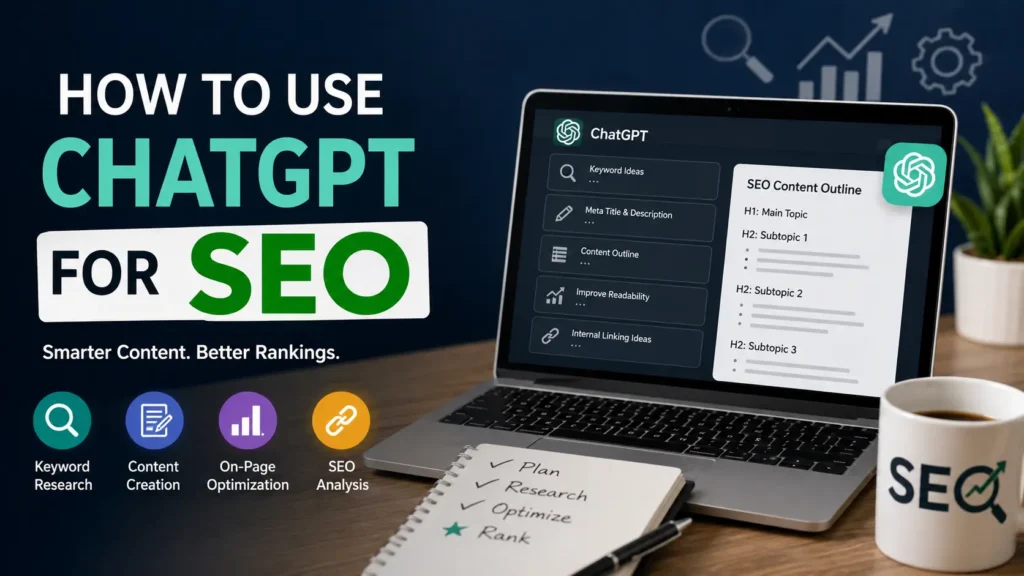
Want a fast answer? Use ChatGPT for keyword clusters, outlines, meta tags, schema markup, and audit checklists, then verify every fact with real SEO tools before you publish. That’s the short version. The long version matters more, because most people use it wrong and end up with thin pages that never rank.
This guide breaks down exactly how to use ChatGPT for SEO in 2026, step by step, with real prompts and a workflow you can copy today.
What Is ChatGPT in SEO?
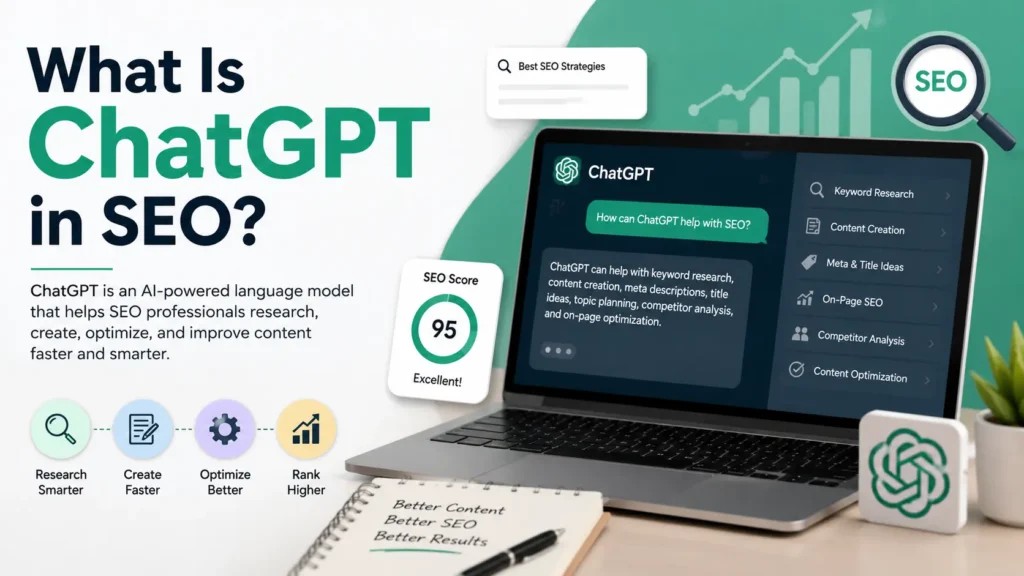
ChatGPT is an AI writing and research assistant. In SEO, people use it to speed up keyword research, draft outlines, write first drafts, and check technical issues. It doesn’t rank pages on its own. It helps you think faster and write better, but the final content still needs your judgment, your data, and your edits.
Google’s December 2025 core update pushed this point hard. Sites with generic AI paragraphs and no real experience behind them lost visibility. Pages built by people who actually know their topic, and who used ChatGPT as a tool instead of a replacement for expertise, held steady or grew. That’s the line you need to stay on.
If you want to learn this properly instead of guessing, structured training helps. LocalPro1 Institute runs practical SEO courses in Rawalpindi that cover AI tools, keyword strategy, and on-page optimization taught by people who rank real client sites, not just theory from a slide deck.
Can ChatGPT Improve SEO Rankings?
Yes, indirectly. ChatGPT won’t push a page to position one by itself. What it does is cut the time you spend on research, drafting, and formatting, so you can publish more well structured content, faster. It also helps you spot content gaps, write cleaner meta tags, and organize topics into clusters that search engines understand.
The catch is quality control. ChatGPT sometimes invents statistics or misstates facts. Every claim needs a check against a real source before it goes live. Skip that step and you risk publishing wrong information, which hurts trust and rankings both.
How to Use ChatGPT for Keyword Research
ChatGPT is good at brainstorming, not at giving you real search volume. Use it to expand a seed keyword into related terms, then confirm numbers in a tool like Google Keyword Planner or Ahrefs.
Try this approach:
- Give ChatGPT your main topic and ask for 30 related long tail keywords grouped by search intent.
- Ask it to sort keywords into informational, commercial, and transactional buckets.
- Ask for question based keywords people type into Google and AI chat tools.
- Cross check volume and difficulty in a dedicated keyword tool before finalizing your list.
This combination of ChatGPT for keyword research and a real data tool gives you both speed and accuracy.
How to Use ChatGPT for Content Planning
Once you have your keywords, ask ChatGPT to build a content calendar around topic clusters instead of single isolated posts. Group related keywords under one pillar page, then plan supporting articles that link back to it.
Ask ChatGPT to map out:
- A pillar topic and 8 to 10 supporting subtopics
- Search intent for each subtopic
- Suggested internal linking between pages
- Content gaps your competitors haven’t covered yet
This builds the topic depth Google rewards, because it shows your site covers a subject fully instead of publishing one thin page and moving on.
How to Use ChatGPT for Writing SEO Content
This is where most people go wrong. They ask ChatGPT to write a full article and publish it as is. That content reads generic, and Google’s helpful content systems are built to catch exactly that pattern.
Instead, use ChatGPT as a drafting partner:
- Feed it your outline, target keyword, and any research notes or data you already have.
- Ask for a first draft based only on what you gave it, not general knowledge.
- Rewrite sections in your own voice and add specific examples from your own experience.
- Insert real numbers, case studies, or client results ChatGPT could never know on its own.
This is how AI SEO content writing stays useful without becoming spammy. The AI handles structure and speed. You add the proof and the personality.
How to Use ChatGPT for On-Page SEO
ChatGPT handles on-page tasks well because they follow clear patterns. Ask it to:
- Write 3 to 5 title tag options under 60 characters
- Draft a meta description under 150 characters with the target keyword
- Suggest header structure (H1, H2, H3) based on your outline
- Write alt text for images that describes the image and includes context, not just keywords
- Check keyword placement in your first 100 words
Always review the output. ChatGPT sometimes writes titles that are too long or descriptions that don’t match your actual page content.
How to Use ChatGPT for Technical SEO
ChatGPT can explain technical concepts and even write code snippets, but it can’t crawl your site. Use it to:
- Generate schema markup templates (FAQ, article, product, local business)
- Explain what a specific error in Google Search Console means and how to fix it
- Draft a robots.txt file based on your site structure
- Write canonical tag logic for duplicate pages
Paste your actual site data or error messages into the chat for accurate answers. Generic questions get generic answers.
How to Use ChatGPT for Local SEO
Local businesses can use ChatGPT to draft Google Business Profile descriptions, local landing page copy, and location specific FAQs. Ask it to write content around neighborhood names, local landmarks, and city specific search terms your customers actually use.
It also helps write review response templates and local schema markup, both of which support local pack rankings when combined with consistent business information across the web.
How to Use ChatGPT for Ecommerce SEO
Product pages need unique descriptions, not copied manufacturer text. ChatGPT can draft product descriptions fast when you feed it real specs, use cases, and customer pain points. Ask it to write comparison content between similar products, size guides, and category page intros that target broader commercial keywords.
Always add real product photos, actual customer questions, and genuine reviews. That’s the experience signal Google looks for on ecommerce pages now.
How to Use ChatGPT for Link Building
ChatGPT won’t get you backlinks directly, but it speeds up outreach. Use it to draft personalized outreach emails, guest post pitches, and broken link building templates. Ask it to research what topics are trending in your niche so your pitch matches what editors actually want.
Never let it send emails automatically or generate fake author bios. Real relationships still drive real links.
How to Use ChatGPT for SEO Audits
Paste in your page content, meta tags, and header structure, and ask ChatGPT to flag issues like thin content, missing keywords, duplicate headers, or unclear intent. It can also compare your page against a competitor’s page you paste in, highlighting gaps in depth or structure.
This won’t replace a full technical crawl from a tool like Screaming Frog, but it catches obvious content problems fast.
Best ChatGPT Prompts for SEO
These ChatGPT SEO prompts work well as starting templates:
- “Act as an SEO strategist. Give me 15 long tail keywords for [topic] grouped by search intent.”
- “Review this outline for [topic] and tell me what subtopics are missing.”
- “Rewrite this paragraph for a 6th grade reading level without losing the technical meaning.”
- “Suggest 5 internal linking opportunities for this article based on [list of existing pages].”
- “Generate FAQ schema markup for these five questions: [list].”
Always edit the output. Treat these prompts as a starting point, not a final answer.
Common Mistakes When Using ChatGPT for SEO
- Publishing AI drafts without fact checking or personal input
- Stuffing keywords unnaturally because ChatGPT suggested a high count
- Relying on it for real time search volume or ranking data
- Skipping internal linking because the AI didn’t suggest it
- Ignoring E-E-A-T signals like author bios and real experience
Best Practices for Using ChatGPT for SEO in 2026
Treat ChatGPT as a research and drafting assistant, not a publisher. Add original data, screenshots, and personal insight to every piece. Keep sentences short and structure content around actual search intent. Update old posts using ChatGPT to spot gaps, then fill those gaps with real expertise.
ChatGPT vs Traditional SEO Tools
ChatGPT writes and brainstorms. Tools like Ahrefs, SEMrush, and Search Console measure actual performance, volume, and rankings. Using ChatGPT for SEO works best when paired with these tools, not instead of them. One handles ideas and drafts. The other handles data and proof.
SEO Tasks You Should Not Rely on ChatGPT Alone For
Don’t trust it alone for exact search volume, backlink audits, site speed diagnostics, or algorithm update analysis. These need live data from crawlers and analytics platforms, not a language model’s best guess.
Recommended SEO Tools to Use Alongside ChatGPT
Google Search Console, Google Keyword Planner, Ahrefs, SEMrush, Screaming Frog, and PageSpeed Insights all fill the gaps ChatGPT can’t cover. Use ChatGPT for speed and structure, these tools for accuracy.
Real Workflow: Using ChatGPT for SEO Step by Step
- Research keywords with ChatGPT, confirm volume in a keyword tool
- Build a topic cluster and content calendar
- Draft an outline and get ChatGPT’s first pass
- Rewrite with your own examples, data, and voice
- Generate meta tags, schema, and alt text
- Fact check every claim before publishing
- Track rankings and update content quarterly
Conclusion
ChatGPT speeds up nearly every stage of SEO work, from keyword research to audits to on-page fixes. It can’t replace real experience, real data, or a human editor who checks the facts. Use it as a fast, capable assistant, add your own proof and voice, and you’ll build content that satisfies both readers and Google’s helpful content systems.
If you want expert guidance to improve your website’s rankings, create high-quality SEO content, or build a results-driven SEO strategy, contact us today. Our team is ready to help you grow your online visibility with proven SEO solutions.
FAQs
Is it safe to publish ChatGPT content directly on my website?
No. Always edit for accuracy, add original insight, and check for factual errors before publishing.
Can ChatGPT replace an SEO specialist?
No. It speeds up tasks like drafting and research, but strategy, data analysis, and technical audits still need a human expert.
Does using ChatGPT for SEO content hurt rankings?
Not by itself. Thin, generic, unedited AI content hurts rankings. Well edited, fact checked content performs fine.
What’s the best way to use ChatGPT for keyword research?
Use it to brainstorm related terms and group them by intent, then confirm volume and difficulty in a dedicated keyword tool.
How often should I update AI assisted content?
Review and update key pages every 3 to 6 months, especially after major Google core updates.