

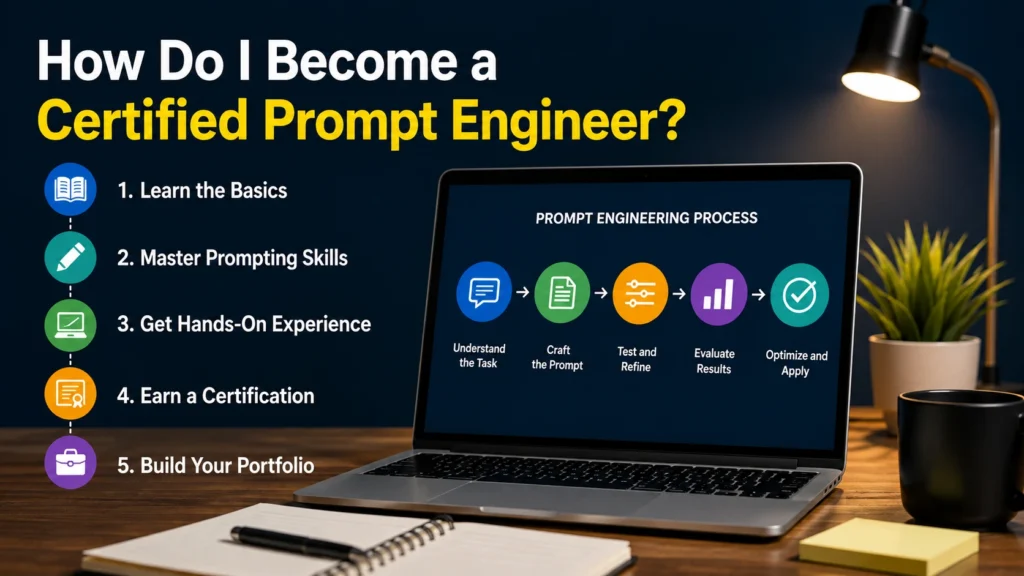
You become a certified prompt engineer by learning core AI skills, practicing with real tools, and completing a recognized course. Most paths take 4 to 12 weeks. You don’t need a coding background to start.
That’s the short answer. But there’s more to it if you want a career, not just a certificate. This guide walks you through the full path, so you can pick the right course and build a portfolio that gets you hired.
What Is a Prompt Engineer?
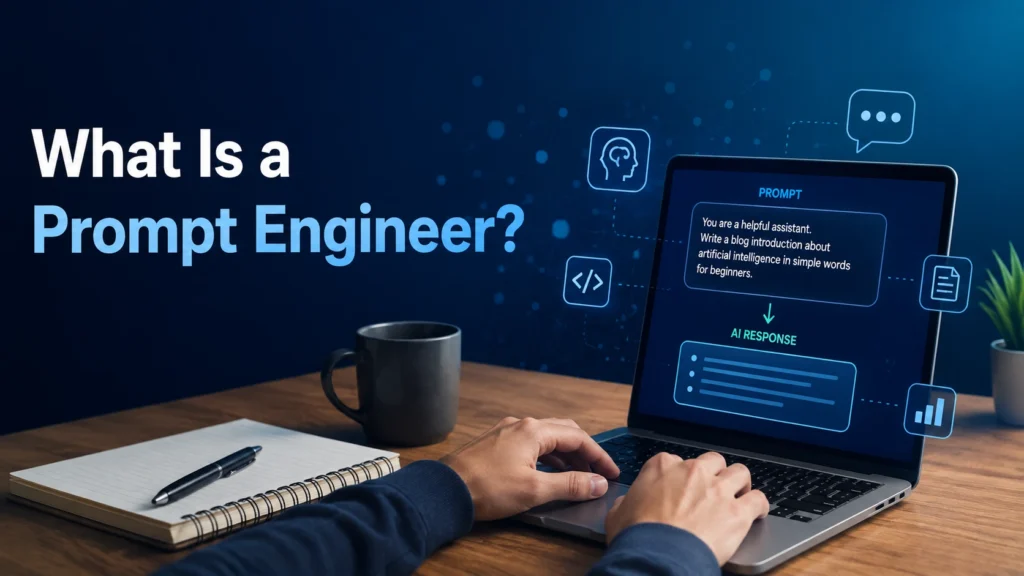
A prompt engineer writes and tests instructions for AI models. Their job is to get accurate, useful output from tools like ChatGPT, Claude, and Gemini. Good prompt engineers understand how a model reads language. They know how small word changes can shift a whole response. This is a new field. It grew out of the rise of large language models over the past few years. Companies now hire people for this skill under different job titles: AI trainer, LLM specialist, or applied AI consultant.
What Does a Prompt Engineer Do?
Day to day work varies by company, but most prompt engineers do a mix of these tasks:
- Write and test prompts for chatbots, content tools, or internal AI systems
- Fix outputs that are wrong, biased, or off topic
- Build prompt templates that other teams can reuse
- Document what works and what doesn’t
- Work with product and data teams to improve AI features
Some roles focus on customer facing tools. Others sit inside data science teams and support model evaluation. The core skill stays the same: clear, structured communication with a machine.
Do You Need a Degree to Become a Prompt Engineer?
No. A degree helps, but it isn’t required. Many working prompt engineers came from writing, marketing, customer support, or teaching backgrounds. What matters more is your ability to think in steps and test your work. Employers care about your portfolio and your grasp of how models behave. A strong certificate plus real project examples can outweigh a formal degree for most entry level roles.
What Skills Do You Need to Become a Prompt Engineer?
You’ll want a mix of technical and soft skills:
- Clear writing. Prompts are instructions, so vague language leads to vague answers.
- Basic logic and structure. You should be able to break a task into steps.
- Familiarity with AI tools. Spend real time inside ChatGPT, Claude, and Gemini.
- Testing habits. Change one variable at a time and track the result.
- Light technical knowledge. You don’t need to code, but knowing what an API or a token is helps.
Curiosity matters more than any single skill on this list. The best prompt engineers keep testing after they get a decent answer, because a decent answer is rarely the best one.
How Do You Become a Certified Prompt Engineer?
If you’re asking how do I become a certified prompt engineer, follow this path:
- Learn the fundamentals through free resources first, such as DeepLearning.AI’s short courses.
- Pick one structured, paid certification to build depth and get a credential.
- Practice on real prompts daily, not just course exercises.
- Build three to five portfolio projects that show your process.
- Apply for roles or freelance gigs while you keep learning.
This order matters. Free courses teach you the basics without cost. A paid certificate then adds structure and a credential you can list on your resume. Skipping straight to a paid cert without any hands on practice often wastes money, since you’ll spend the course catching up on basics instead of building real skill.
Which Prompt Engineering Certifications Are Worth Considering?
There’s no single official license for this field yet, so a prompt engineering certification really means a respected course completion certificate. A few stand out in 2026:
- Vanderbilt Prompt Engineering Specialization (Coursera). A widely recognized university backed program. Good for a LinkedIn credential and a general grounding in prompt design.
- DeepLearning.AI short courses. Free, code focused, and built with input from major AI labs. Great starting point before you pay for anything.
- Google and IBM AI certificates. These cover prompt engineering as part of a broader AI fundamentals track. Useful if you want a big brand name on your resume.
- Databricks and cloud platform certifications. Better suited to engineers who already work with data pipelines and want to add prompt and RAG skills on top.
Read the syllabus before you enroll. Some programs are outdated and still teach patterns built only for older chatbot versions. Check the last update date on any prompt engineering course before paying for it.
How Long Does It Take to Become a Certified Prompt Engineer?
Most people finish a single prompt engineering certification in 20 to 60 hours of study. Spread over a few weeks of part time work, that’s about 4 to 8 weeks. If you’re starting from zero and want a full skill set, budget 3 months. That gives you time for the free fundamentals, one certification, and a small portfolio. Rushing through a course without practice will leave gaps that show up in interviews.
How Much Does Prompt Engineering Certification Cost?
Prices vary a lot. Free options exist from DeepLearning.AI and some community platforms. Paid programs range from about $49 to $399. University backed Coursera specializations often run near $49 a month until you finish. Cloud certification exams from Google or AWS cost $200 to $300, but those cover far more than prompt engineering alone. You don’t need to spend a lot to start. One solid free course plus one affordable paid certificate covers most beginners well.
How Do You Build a Prompt Engineering Portfolio?
A portfolio proves you can do the work, not just pass a quiz. Build these:
- A before and after example, showing a weak prompt and your improved version, with reasoning.
- A small automation, like a prompt template that summarizes documents or drafts emails.
- A test log, where you compare outputs across different models on the same task.
- A written case study explaining your process, not just your final result.
Post these on GitHub, a personal site, or even a public Notion page. Hiring managers want to see how you think, not just what you produced.
What Tools Should You Learn as a Prompt Engineer?
You should get comfortable with the major chat models first: ChatGPT, Claude, and Gemini. Learn how each one responds differently to the same prompt. Then move into tools that show output quality at scale, like prompt testing dashboards and API playgrounds.
If you’re based in Pakistan and want structured, hands on training, Localpro1 institute offers practical prompt engineering courses in Rawalpindi that cover these tools with real projects, not just theory. Local, guided practice like this can shorten your learning curve, especially if you’re new to AI tools altogether.
Can You Become a Prompt Engineer Without Coding?
Yes. Many prompt engineering roles need zero code. Your main tool is language, not syntax. That said, light technical literacy helps you go further. Knowing what an API call does, or how a system prompt differs from a user prompt, opens up better roles. If you want to stay purely non technical, focus on content heavy industries: marketing, education, and customer support all hire non coding prompt specialists.
Is Prompt Engineering a Good Career in 2026?
It’s a good skill, though the job title itself is shifting. Fewer companies post standalone “prompt engineer” openings compared to two years ago. Instead, the skill gets folded into roles like AI product manager, AI trainer, or applied AI consultant. This doesn’t make the skill less valuable. It means you should market prompt engineering as one strength among several, not your only offering. Pair it with writing, data analysis, or product skills for the strongest resume.
Common Mistakes Beginners Make in Prompt Engineering
- Writing vague prompts and blaming the model for bad output
- Testing only one AI tool instead of comparing several
- Skipping practice and jumping straight to a certificate exam
- Ignoring documentation. Anthropic and OpenAI publish free, current guides that beat most paid courses.
- Treating a certificate as the finish line instead of the starting point
Avoid these and you’ll move faster than most beginners in this space.
Conclusion
So, how do I become a certified prompt engineer? Start with free fundamentals, choose one solid certification, then build a portfolio that proves you can apply what you learned. The certificate opens the door. Your projects and practice keep it open. Prompt engineering as a career keeps changing, but the underlying skill, clear thinking and clear instructions, will stay useful no matter what the job titles look like next year.
Ready to build your AI skills? Contact us today to learn more about prompt engineering training at Localpro1 Institute.
FAQs
Is there an official prompt engineering certification?
No single governing body issues one universal license yet. Most “certifications” are course completion certificates from platforms like Coursera, DeepLearning.AI, or cloud providers.
Can I become a certified prompt engineer in a month?
Yes, if you already understand AI tools well. A focused course can take as little as 20 to 30 hours, but real skill takes longer to build through practice.
Do I need to know Python for prompt engineering?
No. Most prompt engineering work is language based, not code based. Python helps for advanced roles involving automation or API work.
What is the average salary for a certified prompt engineer?
Pay varies widely by region and role, and it often gets folded into broader AI or content roles rather than listed as a standalone salary line.
Which certification looks best on a resume?
The Vanderbilt specialization on Coursera is widely recognized for a general audience. For technical roles, a cloud platform certification carries more weight.