

Choosing the right language shapes how fast your site loads and how easy it is to grow. Many beginners struggle with this decision. Some pick a language just because a friend uses it. That approach often leads to wasted time later.
This guide breaks down five top languages used today. You will see real use cases, key frameworks, and companies that rely on them. By the end, you will know exactly which language is best for web development based on your goals.
What Is A Web Development Programming Language?
A web development programming language is a tool developers use to build websites and apps. It tells a browser or server how to display content and respond to user actions. Some languages handle what users see on screen. Others manage data behind the scenes.
Without these languages, websites would stay blank pages with no function. Every button click, form submission, and page load depends on code written in one of these languages.
Frontend Vs Backend Vs Full-Stack Languages
Frontend languages control what a visitor sees and touches. This includes layout, colors, buttons, and animations. HTML, CSS, and JavaScript fall into this group.
Backend languages run on the server. They handle logins, database queries, and business logic that users never see directly. Python, PHP, and Java are common backend choices.
Full-stack languages work on both sides. JavaScript is the clearest example. With Node.js, it powers both the browser and the server, which is why many teams pick it for entire projects.
5 Best Languages For Web Development
Picking the best coding language for web development depends on your project size, budget, and team skill. Here are five languages worth serious consideration.
JavaScript
JavaScript runs in nearly every browser on the planet. It adds interaction to pages without needing a reload. This makes it a strong pick for anyone asking which language is best for web development.
Key features include event handling, asynchronous code, and a massive package ecosystem through npm. It works for both small widgets and large applications.
Use cases: single-page apps, real-time dashboards, chat tools, and browser games.
Popular frameworks: React, Angular, Vue, and Node.js for backend work.
Companies using it: Netflix, LinkedIn, and Airbnb all rely on JavaScript at scale.
Python
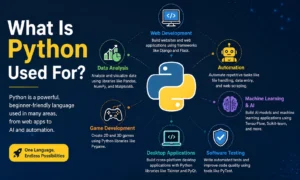
Python reads almost like plain English. That makes it one of the best programming languages for websites when a team wants fast development without a steep learning curve.
Key features include clean syntax, strong library support, and solid tools for handling data-heavy pages.
Use cases: content platforms, APIs, admin dashboards, and apps that process large amounts of data.
Popular frameworks: Django and Flask.
Companies using it: Instagram and Spotify both run parts of their platforms on Python.
PHP
PHP still powers a huge share of the internet. It works directly with HTML and connects easily to databases like MySQL.
Key features include built-in database support, wide hosting compatibility, and a low barrier to entry for new developers.
Use cases: content management systems, blogs, and online stores.
Popular frameworks: Laravel and Symfony.
Companies using it: WordPress, which runs a large portion of the web, is built on PHP.
Java
Java suits large projects that need to run for years without major issues. It handles heavy traffic well and works across different operating systems.
Key features include strong security, automatic memory handling, and a mature set of libraries built over decades.
Use cases: banking platforms, enterprise portals, and large booking systems.
Popular frameworks: Spring Boot and Hibernate.
Companies using it: Amazon and eBay use Java for core backend systems.
TypeScript
TypeScript builds on JavaScript by adding type checking. This catches mistakes before code even runs, which saves time on large teams.
Key features include better code completion, fewer runtime errors, and smooth integration with existing JavaScript projects.
Use cases: enterprise dashboards, large e-commerce platforms, and apps with many contributors.
Popular frameworks: Angular is built with TypeScript, and it works well with React too.
Companies using it: Microsoft and Slack both build major products with TypeScript.
Read More: How Long Does It Take to Become a Web Developer?
Comparison Table
| Language | Type | Difficulty | Performance | Best For |
| JavaScript | Full-stack | Medium | High | Interactive websites |
| Python | Backend | Easy | Medium | Data-driven apps |
| PHP | Backend | Easy | Medium | CMS and blogs |
| Java | Backend | Hard | High | Enterprise systems |
| TypeScript | Full-stack | Medium | High | Large team projects |
How To Choose The Best Language For Web Development
Start with your project type. A small business site needs less power than a booking platform with thousands of daily users.
Check your budget and timeline. Python and PHP tend to speed up early development. Java and TypeScript often pay off more on long, complex builds.
Think about your team. Hiring is easier when you pick a language with a strong local talent pool. In Pakistan, JavaScript and PHP developers are especially easy to find, which keeps hiring and maintenance simple. This is one reason LocalPro1 Institute trains students on languages that match real market demand.
Look at the ecosystem too. A language with strong frameworks and libraries saves you from building every feature from scratch.
Mistakes To Avoid When Choosing A Language
Many beginners chase trends instead of project needs. A trendy language is not always the right fit for a simple business site.
Skipping research on hosting support causes problems later. Some languages need specific server setups that cost more to maintain.
Ignoring team skill is another common error. Picking a language nobody on your team knows slows down every stage of the build.
Future Trends In Web Development Languages
TypeScript adoption keeps growing because it reduces bugs in large codebases. More teams are shifting to it every year.
Web Assembly is letting developers run faster code directly inside browsers. This opens the door for languages once limited to desktop apps.
AI-assisted coding tools are changing how developers write and test code, cutting down time spent on repetitive tasks.
Conclusion
There is no single winner when it comes to which language is best for web development. Your project size, budget, and team skill all matter more than trends. JavaScript, Python, PHP, Java, and TypeScript each solve different problems well. If you want expert guidance on picking and learning the right stack, LocalPro1 Institute offers hands-on Web Development in Islamabad, Pakistan, to help you build real projects with confidence.
FAQs
Which language is best for web development for beginners?
Python and PHP are easier starting points because of their simple syntax and large support communities.
What is the top programming language for web development right now?
JavaScript remains the most widely used language across both frontend and backend work.
Can one language handle a full website alone?
Yes. JavaScript with Node.js can manage both frontend and backend tasks in a single project.
Does language choice affect website speed?
Yes. Compiled and typed languages like Java and TypeScript often perform faster on large-scale apps.