

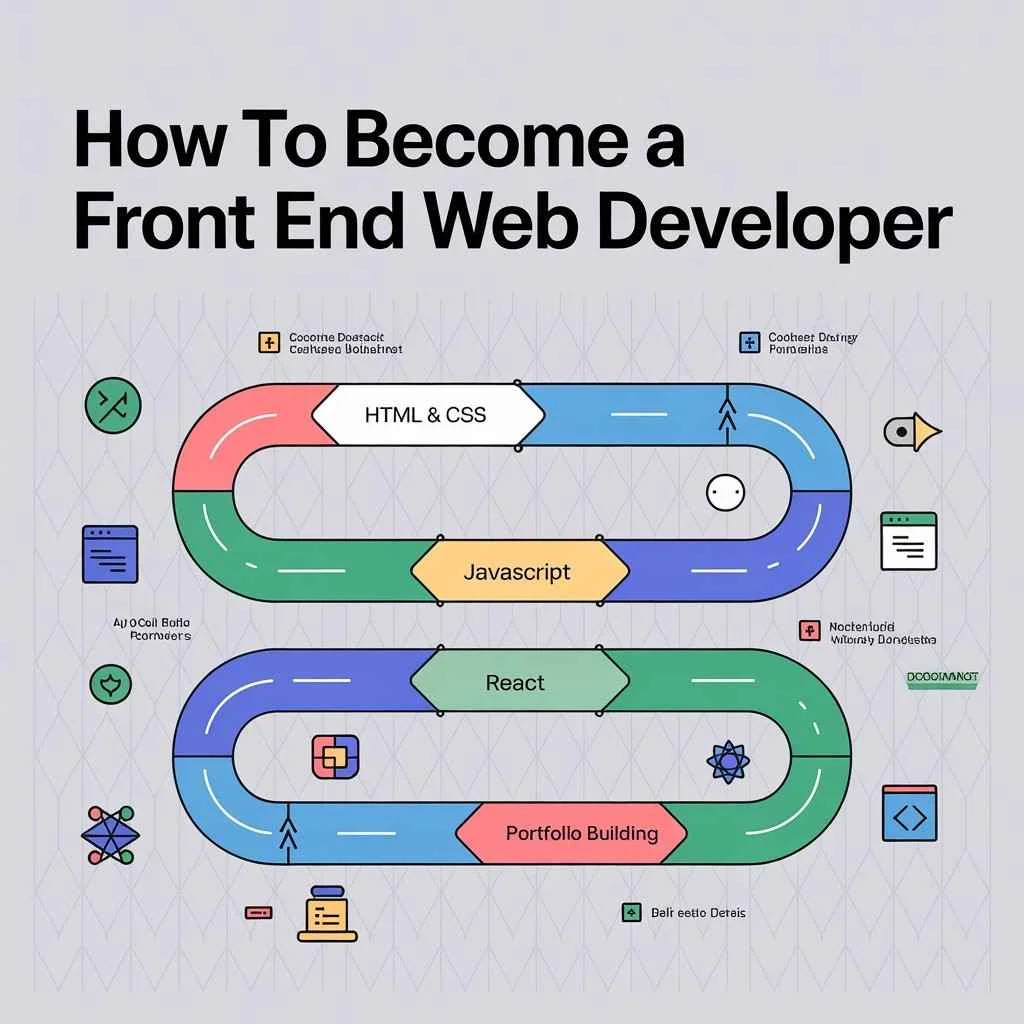
Learning how to become a front end web developer is one of the smartest career moves in tech right now. Front end developers build the parts of websites users actually see and click. The demand is high, and the skill set is very learnable.
This guide covers every step, from zero knowledge to landing your first job. You will learn which skills matter, what tools to use, and how to build a strong portfolio that gets you hired.
Table of Contents
ToggleWhat Does a Front End Web Developer Actually Do?
A front end developer turns design files into working websites. They write HTML, CSS, and JavaScript to create buttons, menus, forms, and animations. They also make sure sites load fast and look good on all screen sizes.
Front end developers work closely with designers and back end developers. They care deeply about user experience and visual performance.
Core Skills You Need to Build First
HTML and CSS
HTML is the skeleton of every webpage. CSS controls how things look. You must know both before touching anything else.
Start with HTML tags, document structure, and semantic elements. Then learn CSS layouts, flexbox, grid, and responsive design.
JavaScript
JavaScript makes pages interactive. It handles clicks, form submissions, pop-ups, and data updates without reloading.
Learn variables, functions, arrays, objects, and DOM manipulation. Then move into ES6+ features like arrow functions and async/await.
Responsive and Mobile-First Design
Every modern site must work on phones. Learn to build layouts that adjust to different screen sizes. Use CSS media queries and flexible grid systems.
Tools Every Front End Developer Uses
Version control with Git is non-negotiable. Every team uses Git to track code changes and collaborate.
Code editors like VS Code are the daily workspace. Learn shortcuts and useful extensions to write code faster.
Browser developer tools let you inspect, debug, and test your code right in Chrome or Firefox.
Package managers like npm help you install libraries and tools quickly.
CSS frameworks like Tailwind CSS or Bootstrap speed up styling. They are not required, but very common in real jobs.
JavaScript Frameworks: What to Learn Next
After vanilla JavaScript, pick one framework. React is the most popular and most in-demand. Vue.js and Angular are also strong choices.
Frameworks help you build complex apps faster. They handle state, routing, and components in a clean, structured way.
Focus on React first. It has the largest job market and the biggest community. Once you understand React, other frameworks become easier to learn.
How to Build a Portfolio That Gets You Hired
A portfolio building process is where most beginners stall. Do not wait until you feel ready. Start building projects from day one.
Your portfolio should have three to five real projects. Each project should solve a real problem or build something useful.
Good project ideas include a weather app, a to-do list with local storage, a blog layout, and a landing page clone.
Push all your code to GitHub. Write clear README files. Hiring managers check GitHub profiles every day.
Learning Path: Step by Step
Month 1 to 2: Learn HTML and CSS. Build three static websites.
Month 3 to 4: Learn JavaScript basics. Add interactivity to your sites.
Month 5 to 6: Learn Git and start using VS Code properly. Learn responsive design.
Month 7 to 9: Learn React. Build two to three React projects.
Month 10 to 12: Apply for jobs. Polish your portfolio. Do code challenges on platforms like LeetCode.
Where to Learn Front End Development
There are many paths. Some people take bootcamps. Others use free online platforms. Some go to university.
If you are in Pakistan and want structured, in-person training, localpro1institute offers a WordPress Development Course in Rawalpindi that covers front end fundamentals, theme development, and real-world project work. It is a strong starting point if you prefer guided learning with hands-on support.
Free resources include MDN Web Docs, freeCodeCamp, and The Odin Project. These are reliable and respected by the developer community.
Paid platforms like Frontend Masters and Scrimba offer structured video courses with interactive coding environments.
Important Concepts Competitors Often Skip
Accessibility
Build websites that work for everyone, including people using screen readers. Use proper heading structure, alt text on images, and keyboard navigation. Google rewards accessible sites with better rankings.
Web Performance
Page speed affects both user experience and SEO. Learn to compress images, reduce JavaScript bundle sizes, and use lazy loading. Tools like Google Lighthouse help you measure and fix performance issues.
Browser Compatibility
Your code must work across Chrome, Firefox, Safari, and Edge. Test in multiple browsers early. Use tools like Can I Use to check feature support.
API Integration
Real apps pull data from back end servers. Learn how to use the Fetch API and handle JSON data. Build a project that connects to a public API like OpenWeather or The Movie Database.
How to Get Your First Front End Job
Apply early, even if you feel underprepared. Most developers get their first job before they feel ready.
Write a clear resume that lists your skills, projects, and GitHub link. Keep it to one page.
Network on LinkedIn. Share your projects. Comment on other developers’ posts. Hiring managers notice active profiles.
Practice coding interviews. Focus on JavaScript fundamentals, problem-solving, and explaining your thought process out loud.
Freelancing is another strong starting path. Platforms like Upwork and Fiverr have steady demand for basic website work. Freelance projects also build your portfolio fast.
Salary Expectations for Front End Developers
Front end developer salaries vary by location and experience. In Pakistan, entry-level front end developers earn between PKR 50,000 and PKR 120,000 per month. Mid-level developers earn significantly more.
Globally, the average front end developer salary is around $75,000 to $110,000 per year in the US. Remote work has opened international opportunities for developers everywhere.
Staying Updated as a Front End Developer
Front end development changes fast. Follow blogs like CSS-Tricks, Smashing Magazine, and the official React blog.
Follow developers on X (formerly Twitter) and LinkedIn. Subscribe to newsletters like JavaScript Weekly and Frontend Focus.
Build something new every month. The best way to stay sharp is to keep coding.
Conclusion
Knowing how to become a front end web developer is the first step. The real work is building the skills, projects, and habits that get you hired. Start with HTML and CSS, move to JavaScript, pick a framework, and build real projects. If you want structured guidance, localpro1institute in Rawalpindi provides practical, career-focused training in web development, Contact us now. Ready to start your journey? Pick one skill today and write your first line of code.
Frequently Asked Questions (FAQs)
Do I need a computer science degree to become a front end web developer?
No, a computer science degree is not required. Many successful front end developers are self-taught or learned through online courses, bootcamps, and practical projects. Employers usually care more about your portfolio, coding skills, and real-world experience than formal education.
How long does it take to become a front end developer?
For most beginners, it takes around 6 to 12 months of consistent learning and practice to become job-ready. The timeline depends on how many hours you study daily and how often you build real projects.
Which programming languages should I learn first?
Start with HTML, CSS, and JavaScript. These are the core technologies used in front end development. After mastering them, you can move to frameworks like React, Vue, or Angular.
Is front end development a good career in 2026?
Yes, front end development remains one of the most in-demand tech careers in 2026. Businesses need fast, mobile-friendly, and user-focused websites, which keeps demand for skilled front end developers very strong worldwide.
Can I become a front end developer without coding experience?
Yes, absolute beginners can learn front end development from scratch. Start with basic HTML and CSS, then slowly move into JavaScript and responsive design concepts.
What is the difference between front end and back end development?
Front end development focuses on the visual and interactive parts of a website that users see. Back end development handles servers, databases, and application logic working behind the scenes.
Which framework is best for front end development?
React is currently the most popular front end framework because of its large community, strong job market, and flexibility. However, Vue.js and Angular are also widely used in professional projects.