

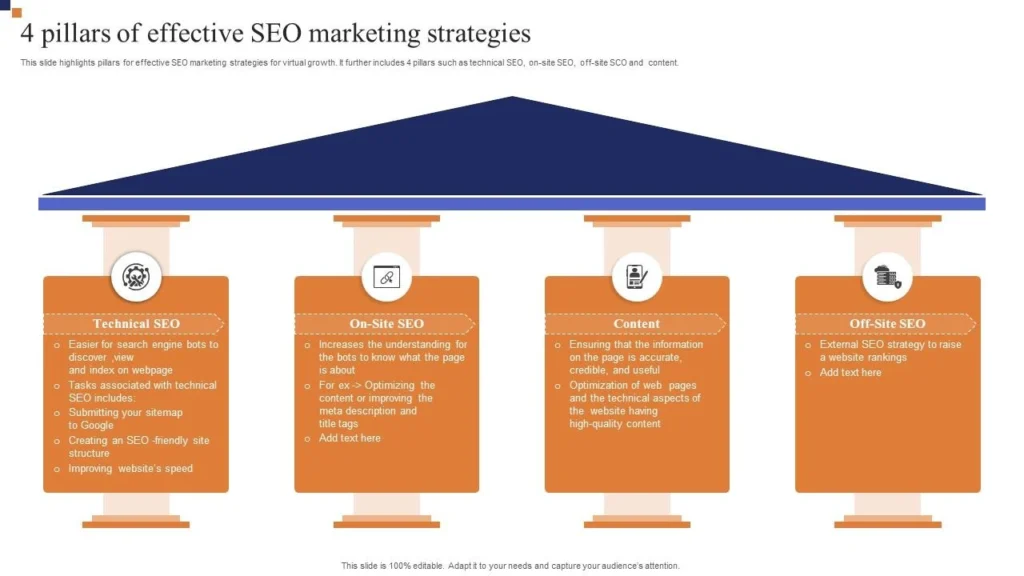
SEO stands on four pillars: technical SEO, on-page SEO, content SEO, and off-page SEO. Each one does a separate job. Technical SEO makes your site easy to crawl and fast to load. On-page SEO makes each page clear and relevant. Content SEO builds depth and trust. Off-page SEO builds authority through links and mentions from other sites.
So what are the 4 pillars of SEO in real practice? They work as one system, not four separate tasks. Skip one pillar and your rankings stall, no matter how hard you push the rest.
Table of Contents
ToggleWhat Are the 4 Pillars of SEO?
When people ask, “what are the 4 pillars of SEO,” they usually want a plain answer, not a wall of jargon. Here it is in simple terms.
The four pillars of SEO are the main areas Google checks before it trusts a page enough to rank it. Think of them as four legs on a table. If one leg is short, the table wobbles. Your rankings work the same way.
- Technical SEO covers how well search engines can crawl, read, and index your site.
- On-page SEO covers how well each page is set up around a topic or keyword.
- Content SEO covers how useful, deep, and original your writing actually is.
- Off-page SEO covers how much trust and authority your site earns from outside sources.
Some writers list these as “technical SEO, on-page SEO, off-page SEO, and content” in a different order, but the four core elements of SEO stay the same. Once you understand these SEO pillars explained clearly, the rest of SEO strategy gets much easier to plan.
Why the 4 Pillars of SEO Matter for Long-Term Rankings
Google’s core update in December 2025 pushed harder on one idea: pages need real depth and real proof of experience, not just keywords stuffed into a template. Sites that leaned on thin content, weak technical setups, or spammy backlinks lost visibility fast after this rollout.
This is why the four pillars of SEO matter more now than they did a few years ago. A single strong pillar cannot carry a weak site anymore. Google’s systems now compare your page against dozens of competing pages, and it rewards the ones that show clear expertise, a clean site structure, and genuine trust signals.
For local businesses, this shift matters even more. If you run a shop or agency and search for seo services in rawalpindi, you will notice that only sites with strong technical health, clear on-page structure, solid content, and real backlinks show up near the top. Weak, outdated pages get buried, even if they used to rank well.
At Localpro1 Institute, this is the exact approach used with students and clients. Instead of chasing shortcuts, the training and consulting work goes back to these four pillars every time. Sites that fix all four areas together tend to hold their rankings, even through future core updates.
Pillar 1: Technical SEO
Technical SEO is the foundation. If Google cannot crawl your site properly, nothing else matters.
This pillar covers site speed, mobile usability, secure connections, clean URL structures, and proper indexing. It also covers structured data, which helps search engines and AI tools understand what your page is actually about.
A slow page loses visitors before they even read a word. A broken sitemap can hide your best content from Google entirely. Duplicate pages confuse crawlers and split your ranking power across multiple URLs instead of one strong page.
Common technical fixes include:
- Compressing images and using modern file formats
- Fixing broken links and redirect chains
- Adding schema markup for articles, FAQs, and products
- Making sure the site works well on phones, not just desktop
- Submitting a clean XML sitemap to Google Search Console
Technical SEO rarely gets attention because it is invisible to regular readers. But it decides whether your content even gets a fair chance to rank.
Pillar 2: On-Page SEO
On-page SEO is about how well a single page is built around its topic. This includes your title tag, headings, meta description, image alt text, and internal links.
Good on-page SEO does not mean stuffing a keyword into every sentence. Google’s helpful content systems can spot that pattern easily, and it often triggers a ranking drop instead of a boost.
Instead, on-page SEO today means writing clear headings that match what people actually search for, placing your main keyword naturally near the top of the page, and using descriptive alt text on images so both users and search engines understand them.
Internal linking also belongs here. Linking your new pages to older, related pages on your site helps Google understand how your content connects. It also keeps readers on your site longer, which is a strong trust signal.
Pillar 3: Content SEO
Content SEO is the pillar most affected by the December 2025 core update. Google’s systems now look closely at experience, expertise, authority, and trust, often shortened to E-E-A-T.
This means your content needs to show real experience, not just repeated facts pulled from other articles. Original research, real examples, personal insight, and specific details all help prove that a real person with real knowledge wrote the page.
Thin content, meaning short pages with little real value, gets filtered out fast under this update. So does content that only rewords what competitors already say. Google wants pages that answer a question fully, cover related subtopics, and give readers a reason to stay instead of clicking back to the search results.
This pillar also connects directly to Generative Engine Optimization and Answer Engine Optimization. AI Overviews and chatbots pull answers from pages that give clear, direct answers early, followed by real depth and examples. A page that opens with a strong, clear answer has a better shot at being pulled into an AI summary or a featured snippet.
Pillar 4: Off-Page SEO
Off-page SEO covers everything that happens away from your own website. This mainly means backlinks, but it also includes brand mentions, reviews, and social signals.
A backlink from a trusted, relevant site tells Google that other people vouch for your content. Ten weak, spammy links do far less than one strong link from a respected site in your industry.
Off-page SEO also includes digital PR, guest posts on real industry sites, and building a recognizable brand name that people search for directly. Brand searches, where people type your business name into Google, are a strong trust signal that search engines track closely.
Outbound linking plays a role here too. Linking out to trustworthy, well-known sources when you reference facts or data shows Google that your content is well researched, not just written in isolation.
How the Four SEO Pillars Work Together
None of these four pillars work well alone. A technically perfect site with no useful content will not rank. A page packed with expert content on a broken, slow site will not rank either.
Here is a simple way to picture it. Technical SEO gets your page in front of Google. On-page SEO tells Google what the page is about. Content SEO proves the page deserves to rank. Off-page SEO proves other people trust it too.
When you improve all four SEO pillars at the same time, your rankings become far more stable. This is also why sites that only started with a rewrite tool or a plugin often collapse after a core update. They fixed one pillar and ignored the other three.
Common SEO Mistakes That Weaken These Four Pillars
Even experienced site owners make mistakes that quietly weaken these four pillars over time.
- Keyword stuffing: repeating a phrase unnaturally instead of writing normally.
- Thin content: publishing short pages with no real depth or original insight.
- Ignoring site speed: letting a slow site push visitors and rankings away.
- Buying spammy links: using low quality backlinks that Google can flag and penalize.
- Skipping internal links: leaving new pages isolated instead of connected to related content.
- Copying competitors: rewriting existing articles instead of adding something new.
- Forgetting mobile users: building a site that only looks good on desktop screens.
Each mistake usually points back to one weak pillar. Fixing it often means going back to basics instead of chasing a new trick.
A Simple Checklist to Strengthen All Four SEO Pillars
Use this checklist as a quick health check for your site.
Technical SEO
- Site loads in under three seconds
- Mobile version works smoothly
- No broken links or major crawl errors
- Schema markup added where useful
On-page SEO
- Clear title tag and meta description
- Headings match real search intent
- Main keyword placed naturally, not forced
- Internal links added to related pages
Content SEO
- Original examples, data, or personal insight included
- Question answered clearly near the top
- Related subtopics covered in depth
- No copied or reworded competitor content
Off-page SEO
- Backlinks come from relevant, trusted sites
- Brand name mentioned and searched by real users
- Reviews and social proof are visible
- Outbound links point to credible sources
Going through this list every few months keeps all four pillars strong, even as Google’s systems keep changing.
Conclusion
So, what are the 4 pillars of SEO? Technical SEO, on-page SEO, content SEO, and off-page SEO work together as one connected system. After the December 2025 core update, Google rewards websites that build real depth, trust, and value across all four areas instead of relying on shortcuts. Strengthen every pillar consistently, and your rankings become more stable in both Google Search and AI-powered results.
Need help improving your website’s SEO? Contact Localpro1 Institute today. Our team can help you build a strong SEO foundation with proven strategies that support long-term growth, higher rankings, and sustainable organic traffic.
FAQs
What are the 4 pillars of SEO?
The four pillars of SEO are technical SEO, on-page SEO, content SEO, and off-page SEO. Together, they cover how easy your site is to crawl, how well each page is structured, how useful your content is, and how much outside trust your site has earned.
Which pillar matters most for rankings?
No single pillar works alone. A site needs all four core elements of SEO working together to rank and stay ranked, especially after recent core updates.
How did the December 2025 core update affect these pillars?
It placed heavier weight on content SEO, especially real experience and depth, while still requiring a technically sound site and genuine off-page trust signals.
Can a site rank with only strong content and weak technical SEO?
Rarely, and not for long. If Google struggles to crawl or load your site, even excellent content may never get a fair chance to rank.
How often should these four SEO pillars be reviewed?
A review every three to six months helps catch new technical issues, outdated content, and link quality problems before they affect rankings.