

Python isn’t one single thing. Under the hood, several implementations run this popular language, and each one works differently. Some focus on ease of use. Others focus on raw speed. This mix confuses a lot of new coders.
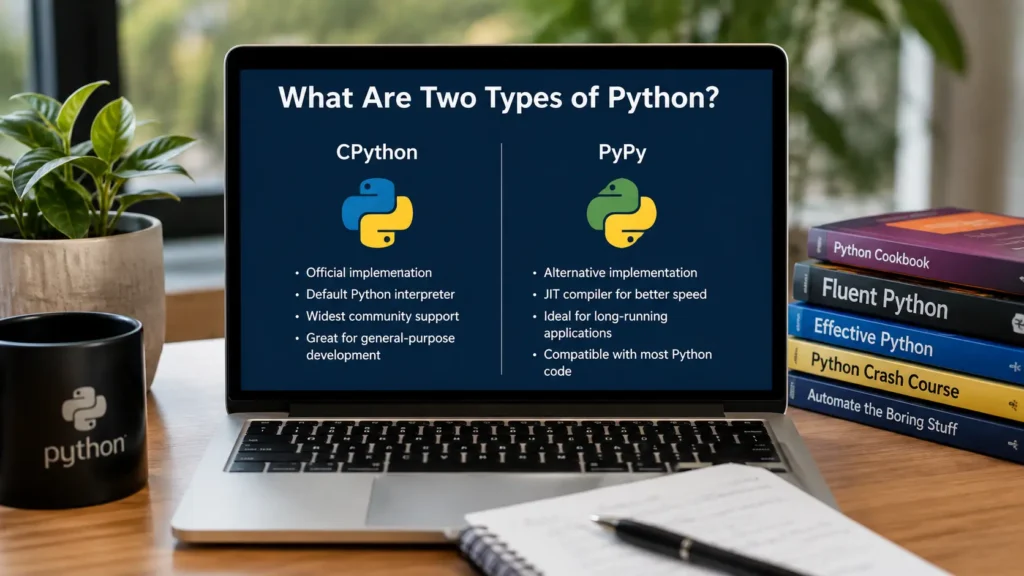
So, what are two types of Python? The two most common implementations are CPython and PyPy. CPython is the standard version. PyPy is built for speed.
What Does “Types of Python” Mean?
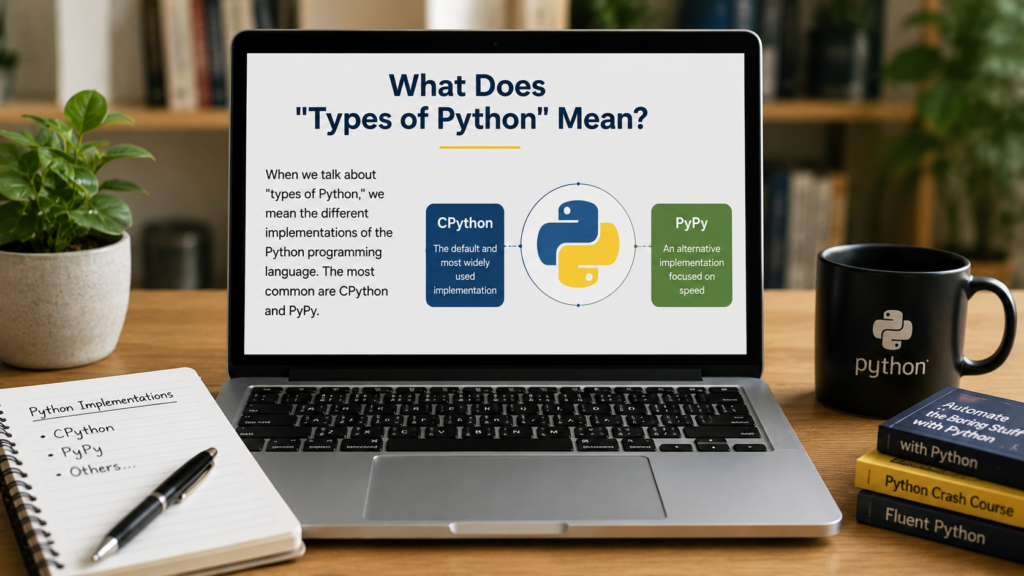
When people say “types of Python,” they usually mean one of two things. They might mean Python versions, like Python 2 and Python 3. Or they might mean Python implementations, the actual programs that read and run your code.
This article focuses on implementations, since that’s where most of the confusion starts. Every Python implementation follows the same language rules. The difference is in how each one turns your code into something your computer can execute. Some implementations translate code line by line. Others compile it first, then run it. That single choice changes speed, memory use, and even which tools you can use.
Understanding different versions of Python matters too, but implementations are the deeper layer most tutorials skip. Once you know how CPython and PyPy work, the rest of the Python ecosystem makes a lot more sense.
What Are the Two Main Types of Python?
The two main types of Python are CPython and PyPy. Both run Python code. Both follow the same syntax rules. But they were built with different goals in mind.
CPython is the original implementation, written in the C programming language. It’s the version you download from python.org. Almost every Python programming tutorial, library, and tool assumes you’re using CPython.
PyPy is a newer implementation, written mostly in Python itself. It was built to solve one specific problem: speed. PyPy can run certain programs several times faster than CPython, especially long-running scripts with heavy loops.
If someone asks you what are two types of Python you’ll run into most often, the honest answer is CPython and PyPy. Everything else is a smaller, more specialized branch of the same tree.
CPython Explained
CPython is the reference implementation of Python. That means it sets the standard every other version tries to match. When developers write new Python features, they test them in CPython first.
Here’s how it works. CPython takes your Python code and compiles it into something called bytecode. Then a virtual machine reads that bytecode and runs it, one instruction at a time. This process is simple and reliable, but it isn’t the fastest method available.
CPython has a few strong advantages:
- It supports almost every Python library, including tools for data science and web development.
- It has the largest community, so help is easy to find.
- It’s stable and well tested, since it’s been the default for decades.
The main downside is speed. CPython can feel slow on tasks that involve heavy number crunching or long loops. For most everyday projects, though, this rarely matters.
PyPy Explained
PyPy takes a different approach. Instead of just interpreting bytecode, it uses a technique called just-in-time compilation, or JIT. This means PyPy watches your code as it runs, spots patterns, and compiles the busy parts directly into machine code.
The result is speed. In many benchmarks, PyPy runs pure Python code four to ten times faster than CPython. For programs that loop millions of times, that difference adds up fast.
PyPy isn’t perfect, though. Some libraries, especially ones written in C, don’t work well with it. Support has improved a lot in recent years, but it still lags behind CPython in this area. PyPy also uses more memory for short scripts, since the JIT compiler needs time to warm up before it shows its full speed advantage.
CPython vs PyPy: Key Differences
The CPython vs PyPy comparison comes down to a few clear points.
| Feature | CPython | PyPy |
| Execution method | Interpreted bytecode | Just-in-time compiled |
| Speed | Standard | Often much faster |
| Library support | Excellent | Limited for C extensions |
| Community size | Largest | Smaller, growing |
| Best use case | General projects, learning | Long-running, CPU-heavy tasks |
CPython wins on compatibility. PyPy wins on raw speed for the right kind of workload. Neither one is “better” in every situation. The right choice depends entirely on what you’re building.
Which Python Type Should Beginners Learn?
If you’re new to coding, start with CPython. It’s the default choice for a reason. Every book, course, and tutorial assumes you’re using it. Every library installs cleanly with it. You won’t hit strange compatibility issues while you’re still learning the basics.
This is exactly why Python for beginners almost always means CPython first. You can explore PyPy later, once you understand how Python programming actually works and you run into a real performance problem that needs solving.
If you’re based locally and want structured, hands-on guidance instead of piecing things together from scattered videos, LocalPro1 Institute offers Python courses in Rawalpindi designed for real beginners. A good instructor can save you months of trial and error, especially when you’re deciding between different versions of Python and different implementations for the first time.
Other Python Implementations You Should Know
CPython and PyPy aren’t the only options. A few others are worth knowing, even if you never use them directly.
- Jython: Runs Python code on the Java Virtual Machine. Useful if you’re working inside a Java-based system.
- IronPython: Built for the .NET framework. Handy for teams already working with Microsoft tools.
- MicroPython: A stripped-down version made for microcontrollers and small embedded devices.
- Stackless Python: A CPython variant built for lightweight tasks called microthreads, often used in game development.
None of these compete directly with CPython or PyPy for everyday use. But they show how flexible Python’s design really is. The language itself isn’t tied to one single engine.
How to Choose the Right Python Implementation
Picking the right implementation comes down to three questions.
First, what are you building? Web apps, scripts, and data analysis projects run fine on CPython. Long-running number crunching or simulations may benefit from PyPy.
Second, which libraries do you need? If your project depends on tools like NumPy or Django, check their PyPy compatibility first. Some work fine. Others don’t.
Third, how much does speed actually matter? Not every project needs the fastest possible execution. If your script runs in two seconds either way, the difference won’t matter to your users.
For most learners and most small to medium projects, CPython remains the safer, simpler choice.
Common Misconceptions About Python Types
A few myths keep circulating about Python types, so let’s clear them up.
Myth: PyPy replaces CPython entirely. Not true. PyPy is a specialized tool, not a full replacement. Most production systems still run on CPython.
Myth: Different versions of Python and different implementations are the same thing. They aren’t. Python 2 and Python 3 are versions. CPython and PyPy are implementations. You can run Python 3 code on either one.
Myth: Beginners need to worry about implementation choice early. They don’t. Learn the language first. Worry about performance tuning once you actually have a performance problem.
Clearing up these points answers what are two types of Python in a way that actually sticks, instead of leaving you with half the picture.
Conclusion
So, what are two types of Python, in short? CPython and PyPy. CPython is the standard, dependable choice most developers use every day. PyPy trades some compatibility for serious speed gains on the right kind of workload.
If you’re just starting out with Python programming, stick with CPython. It has the widest support, the largest community, and the fewest surprises, making it the best choice for beginners. Once you’ve built a few projects and run into real performance limits, PyPy can help speed up your code without major changes. If you want to learn Python the right way with hands-on training, contact us today and enroll in our Python courses to start building practical programming skills.
FAQs
What are two types of Python most developers use?
Most developers use CPython for everyday projects and PyPy for tasks that need extra speed.
Is CPython faster than PyPy?
No. PyPy is usually faster for long-running, loop-heavy code, thanks to its just-in-time compiler.
Can beginners use PyPy?
Yes, but it’s not recommended at first. Stick with CPython while you’re still learning core Python programming concepts.
Are Python 2 and Python 3 considered types of Python?
They’re versions, not implementations. CPython and PyPy are implementations that can both run Python 3 code.
Where can I learn Python properly in Rawalpindi?
LocalPro1 Institute offers Python courses in Rawalpindi for beginners who want guided, structured learning instead of self-teaching alone.