

SEO makes your website easier to find on Google. It helps search engines understand your content and match it with real questions people type every day. Without SEO, even great content stays invisible to the people who need it most.
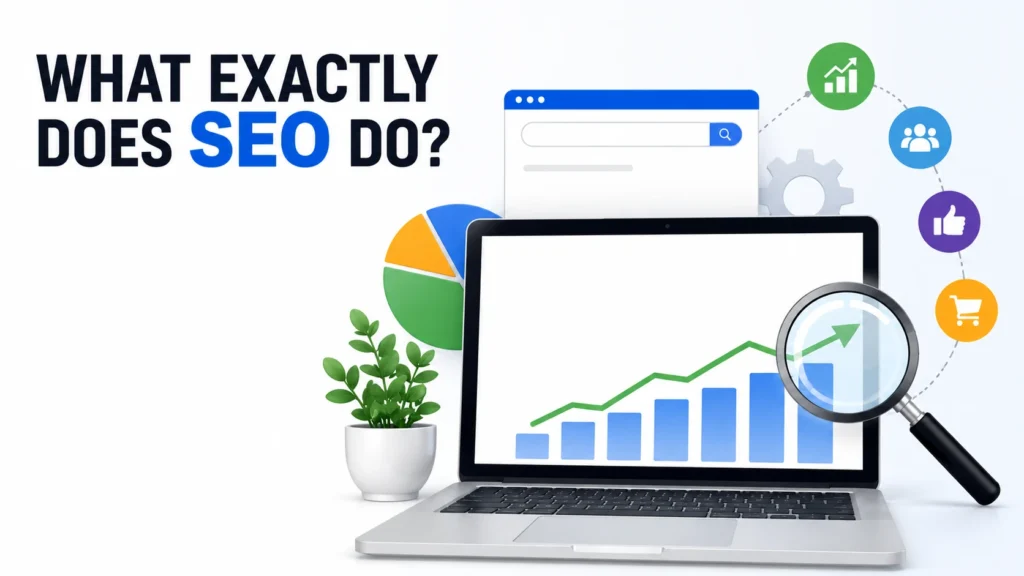
So what exactly does SEO do? It builds trust signals, fixes technical issues, and connects your pages to real search intent. That mix is what turns random clicks into steady traffic.
What Is SEO in Simple Words?
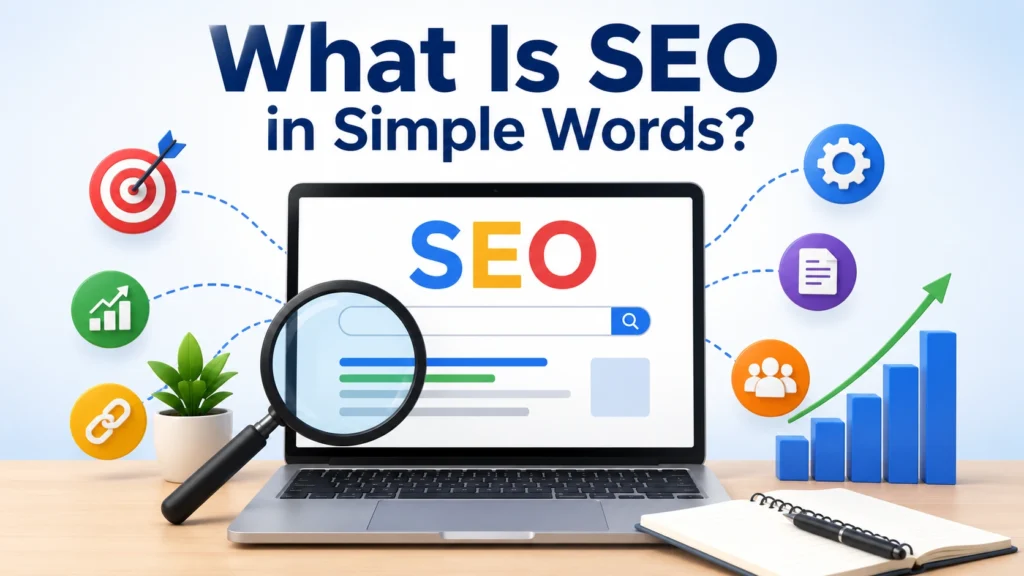
SEO stands for search engine optimization. It is the process of making a website easier for Google to read, trust, and rank.
Think of Google as a librarian with billions of books. SEO is how you label your book so the librarian knows exactly where to place it, and who to hand it to.
Good SEO does not trick search engines. It removes confusion. It gives clear signals about what a page covers, who wrote it, and why it deserves attention.
What Exactly Does SEO Do for a Website?
A website without SEO is like a shop with no sign, no address, and no window display. People might love what is inside, but they will never walk in.
Here is what does SEO do for a website in practical terms:
- It helps search engines crawl and index every important page.
- It matches your content to what people actually search for.
- It builds credibility through content depth and trusted links.
- It improves page speed and mobile usability.
- It keeps your site competitive as Google’s ranking systems change.
None of these steps work alone. SEO is a system, not a single trick. That is the honest answer to what does SEO do for a website.
How Does SEO Work?
Search engines use automated programs called crawlers to scan the web. These crawlers follow links from page to page, reading content along the way.
Once a page is crawled, it gets indexed. Indexing means Google stores that page in its massive database, ready to show it when someone searches a related term.
Ranking happens next. Google’s systems compare thousands of indexed pages and decide which ones best answer a specific query. This is where content quality, site structure, and trust signals matter most.
So how does SEO work in one sentence? It aligns your website with how search engines crawl, understand, and rank content, so the right pages appear for the right searches.
What Did Google’s December 2025 Core Update Change?
Google rolled out its December 2025 core update between December 11 and December 29. It was one of the most volatile updates of the year, and it reshaped how many sites perform in search.
This update did not target spam or add new penalties. Instead, it recalibrated how Google’s core systems judge content usefulness, topical depth, and intent match. Sites built around thin, templated, or repetitive pages lost visibility. Sites with genuine expertise, layered content, and strong page experience gained ground.
A few patterns stood out after the rollout settled:
- Page experience metrics, including load speed, played a real role in outcomes.
- Sites with deep, well-researched content held up better than sites chasing keyword volume alone.
- Domain trust and consistent content activity mattered more than one-off viral pages.
- Weak pages could drag down an otherwise strong site, even if most of the content was solid.
The lesson is simple. What exactly does SEO do after an update like this? It forces every site owner to focus on real value instead of shortcuts. Google is not asking for more content. It is asking for content that actually helps someone.
What Are the Main Things SEO Does?
Beyond rankings, SEO does several jobs that are easy to overlook.
It builds long term visibility. Unlike a single ad campaign, a well optimized page can keep bringing visitors for years.
It improves user experience. Search engines reward sites that load fast, work on mobile, and are easy to navigate. Users benefit from these same fixes.
It signals expertise and trust. This is where E-E-A-T comes in: experience, expertise, authority, and trust. Google wants proof that real people with real knowledge created the content.
It supports every other marketing channel. Paid ads, social posts, and email campaigns all work better when they point to a website that already ranks well and loads fast.
What Are the 4 Main Types of SEO?
- On-page SEO This covers everything inside your page: headings, keyword placement, internal links, image alt text, and content structure. It is the foundation search engines read first.
- Off-page SEO This is about signals from outside your site, mainly backlinks from other trusted websites. When credible sites link to you, it acts like a vote of confidence.
- Technical SEO This handles the backend: site speed, mobile friendliness, secure connections, clean code, and crawlability. A page can have perfect writing and still fail to rank if technical issues block it.
- Local SEO This focuses on ranking for location based searches, like a business trying to appear when someone nearby searches for a service. Google Business Profile optimization sits inside this category.
Each type answers a different piece of what does SEO do for a website. Skipping one weakens the rest.
How Does SEO Increase Website Traffic?
SEO increases traffic by putting your pages in front of people who are already searching for what you offer. This is different from cold traffic, where people have no prior interest.
When a page ranks on the first result page, it captures a steady stream of visitors without ongoing ad spend. As more pages rank for related terms, the traffic compounds. One well optimized blog post can rank for dozens of related searches over time, not just one exact phrase.
This is also where topic depth matters. A single article that fully covers a subject, backed by real research and examples, tends to rank for many related queries instead of just one keyword.
Does SEO Help a Business Get More Customers?
Yes, but only when it is paired with content that actually solves a problem. Traffic alone does not pay bills. Traffic that matches real buying intent does.
SEO helps a business get more customers by:
- Attracting people who are actively searching for a solution, not passively scrolling.
- Building trust before the first conversation even happens.
- Lowering the cost per lead compared to constant paid advertising.
- Creating a steady pipeline instead of a one-time spike in interest.
Why is SEO important for business growth? Because it turns your website into a source of consistent, qualified demand instead of a digital brochure that sits unread.
What Does SEO Do for Google Rankings?
Rankings are the most visible outcome of SEO, but they are the result of many smaller wins. Google looks at relevance, content quality, site trust, page experience, and how well a page satisfies the actual search intent behind a query.
Since the December 2025 core update, Google has leaned harder into comparing pages against each other rather than checking boxes on a fixed checklist. A page does not need to be perfect. It needs to be clearly better and more complete than the pages currently ranking above it.
This is also central to how content performs in AI Overviews and other AI generated answers. These systems pull from pages that clearly state facts, back them with evidence, and organize information in a way that is easy to extract. Clear headings, direct answers, and well structured lists all help both traditional rankings and AI summaries at the same time.
How Long Does SEO Take to Work?
Most sites start seeing meaningful movement between three and six months. Highly competitive industries can take longer, sometimes closer to a year for major keywords.
This timeline exists because Google needs time to crawl new content, compare it against competitors, and confirm that rankings hold steady rather than spike and drop. Rushing this process with shortcuts usually backfires, especially after an update focused on genuine quality.
What Is the Difference Between SEO and Paid Advertising?
Paid advertising buys visibility. The moment you stop paying, the traffic stops too.
SEO builds visibility that can last for years with proper maintenance. It takes longer to show results, but it does not disappear the day your budget runs out.
Most successful businesses use both. Paid ads bring quick, testable traffic. SEO builds a durable asset that keeps working in the background.
How Can You Start Doing SEO?
Starting SEO does not require a huge budget. It requires a clear plan and consistent effort.
- Research the exact terms your customers search for.
- Structure your site so search engines can crawl it without confusion.
- Write content that fully answers a question, not just a surface level summary.
- Fix technical issues like slow load times and broken links.
- Build genuine backlinks from relevant, trustworthy sites.
If you want structured, hands-on training instead of piecing this together alone, SEO courses in Rawalpindi through Localpro1 Institute walk you through each of these steps with real practice, not just theory. Learning the fundamentals properly early on saves months of guesswork later.
Conclusion
What exactly does SEO do? It aligns your website with how search engines and AI systems evaluate content, so the right people find you at the right moment. It is not a one-time task. It is an ongoing process built on real expertise, technical health, and genuine usefulness to the reader.
After the December 2025 core update, that message is clearer than ever. Google is rewarding sites that put real effort into helping their audience, not sites chasing quick wins. If you build with that mindset, rankings tend to follow. Contact us today to improve your SEO strategy and build a website that delivers lasting value.
FAQs
What exactly does SEO do in one sentence?
SEO helps search engines understand, trust, and rank your website so it appears in front of people actively searching for your content or services.
How does SEO work if I already have a website?
It works by improving what is already there: content depth, technical health, and trust signals, rather than starting from scratch.
What does SEO do for a website that already ranks well?
It protects and grows that ranking by adapting to updates like the December 2025 core update, so competitors cannot easily overtake you.
Why is SEO important if I already run paid ads?
Paid ads stop the moment you stop paying. SEO keeps working long after, which lowers your overall cost per customer over time.
What are the benefits of SEO for a small business?
Lower long term marketing costs, steady organic traffic, and stronger trust with local customers searching for nearby solutions.